Why Your Content Calendar Will Fail (And What to Do Instead)
It’s that time of year again. ❄️☃️ That precious week between Christmas and New Year’s when creators and solopreneurs open fresh spreadsheets, map out three months of content themes, go ham on color-code their posting schedule, and feel genuinely optimistic about finally getting organized.
By February, most of those calendars will go the way of most resolutions and be abandoned. (Every year, amirite?)
But FYI, this isn’t a character flaw. No, no, you are not alone. It’s a pattern with some stats to back it up:
- 80% of New Year’s resolutions fail by the second month.1
- 43% don’t even make it through January.2
- The average resolution lasts just 3.74 months before being quietly abandoned.3
If you’re planning an elaborate content system for 2026, you’re planning something that statistically won’t survive the winter. 🥶
The problem with big systems
Content calendars fail for the same reasons most resolutions fail: these are built for motivation, not the reality of life.
When you’re feeling inspired, a 90-day content plan seems totally doable. You’ll batch your content. You’ll stick to themes. You’ll finally be consistent.
But motivation fades, life gets complicated, and the ambitious system you designed requires ambition (and time) that you don’t always have.
Meanwhile, 52% of creators are already dealing with burnout.4 Adding an elaborate planning system to an already overwhelming schedule doesn’t seem like a good solution, tbh.
What actually works
The creators who stay consistent don’t usually have the most sophisticated systems. They have the simplest ones.
Here, give this a try:
- Instead of planning 90 days of content, plan your next 3 posts. That’s it. Three posts you can actually commit to, scheduled for times when they’ll actually land.
- Instead of elaborate theme weeks and content pillars, ask yourself: “Would I even want to read this? Do I think that a past version of myself would’ve found this post useful? Would my audience find this post bookmark-worthy?”
- Instead of tools with umpteen features you’ll never use, find something that does exactly what you need and nothing more… because the best system is the one you’ll actually use at 7 PM on a Tuesday when you’re tired, hangry, and your motivation is nowhere to be found.
The minimum viable content system
Here’s what a sustainable system actually looks like:
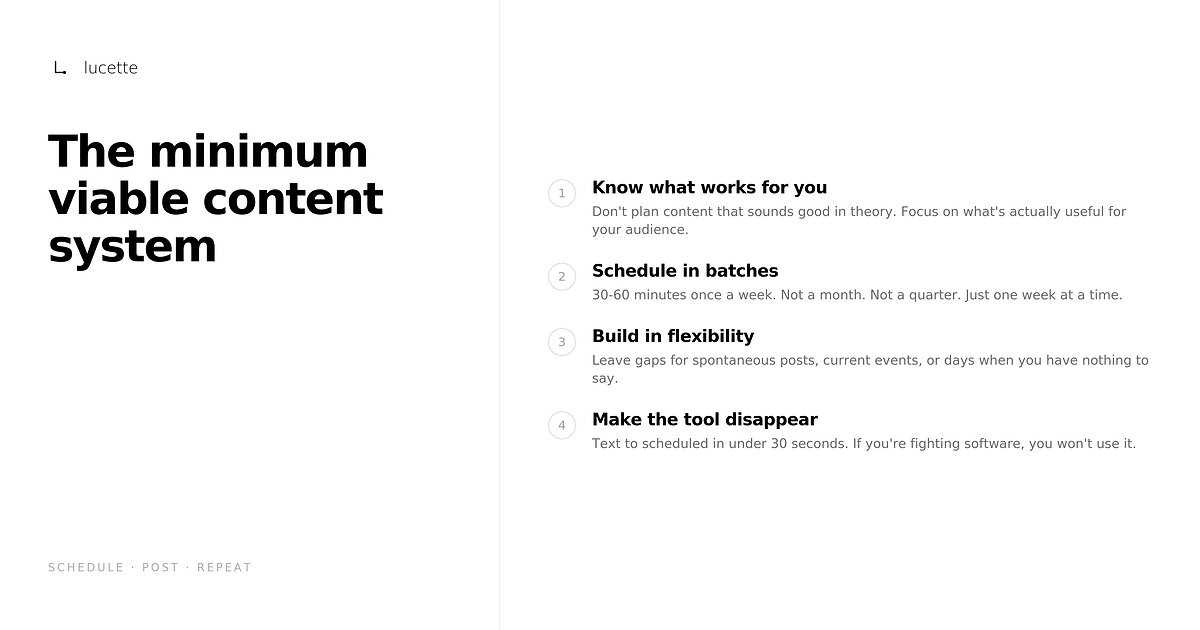
- Know what works for you. Don’t plan content types that sound good in theory just because someone somewhere on the internet said it’s a good topic to write about. Is this something that’ll be useful for your audience?
- Schedule in batches. Once a week, spend 30-60 minutes scheduling your posts for the coming week. Not a month. Not a quarter. A week.
- Build in flexibility. Leave gaps for spontaneous posts, responses to current events, or days when you simply have nothing to say.
- Make the tool disappear. Your scheduling tool should take less than 30 seconds from text entry to save/schedule. If you’re fighting with software, you won’t use it.
The counterintuitive truth
Here’s what nobody tells you about content planning: the goal isn’t to post more. The goal is to post consistently without burning out.
A plan to post three times per week that you actually follow is infinitely more valuable than a plan to post 3x daily that falls apart after two weeks. Consistency isn’t about frequency. It’s about reliability. Your audience learns to expect you. They know when you show up. They notice when you’re there.
Let’s be real: If you’re a content creator, a freelancer, or a solo business owner, you’ve got actual work to do, and you probably don’t have the time or energy to deal with an elaborate content calendar anyway, especially when that process assumes you’ll be hyperfocused on just social media every single day for… forever.
Going into 2026
If you’re tempted to build an ambitious content system this January, ask yourself: what happened to last year’s system?
- If the answer is “It worked great!”, well then hats off to you! Congratulations, and keep going. 👏
- If the answer is “I abandoned it by mid-March, or was it February?”, then maybe the problem wasn’t your discipline. Maybe the problem was the system. 🧐
Start smaller than you think you should. Build consistency before volume. Let your system grow with your capacity instead of betting on capacity you don’t yet have.
The best content strategy for 2026 might be the simplest one you’ve ever tried.
lucette is scheduling stripped to the essentials: write your post, pick your time, done. No complex calendars to abandon. Just a simple queue that actually gets used.
-
U.S. News & World Report. Approximately 80% of New Year’s resolutions fail by the second week of February. ↩
-
Strava “Quitter’s Day” analysis, 2019. Based on 800 million user activities, most people abandon resolutions by the second Friday of January. ↩
-
Forbes Health, “New Year’s Resolution Statistics”, 2024. Average resolution duration: 3.74 months; only 9% complete their resolutions. ↩
-
Billion Dollar Boy, “Creator Burnout Report”, July 2025. Survey of 1,000 US/UK creators by Censuswide. 52% experienced burnout; demanding workload ranked second (31%). ↩